题目:Longitudinal and circumferential bending moment responses of dislocated concrete pipes rehabilitated with CIPP liners under traffic loads(交通荷载作用下CIPP内衬修复错位混凝土管道的纵向和环向弯矩响应)
作者:Hongyuan Fang;Jiayang Sun;Bin Li;Xueming Du;Niannian Wang;Danyang Di;Kejie Zhai
期刊名:Tunnelling and Underground Space Technology
影响因子:6.7
中科院期刊分区:SCI一区
DOI:10.1016/j.tust.2024.106222
收录年份:2025
摘要:由于不均匀沉降和表面荷载等因素引起的混凝土管接头错位,会导致管道结构劣化,甚至失效。如何修复这些管道以提高其抗灾能力和复原力是一个关键问题。以错位混凝土管为研究对象,通过足尺模型箱试验,研究了不同埋深条件下错位混凝土管原位固化修复前后的弯矩响应。此外,考虑埋深、荷载位置、错位形式、CIPP内衬的弯曲模量和内衬厚度等因素,建立了错位混凝土管道与周围土体相互作用的三维有限元模型。对不同埋深的CIPP内衬进行了有限元模型预测和实验测量的比较,验证了模拟结果的可靠性。在此基础上,研究了各种因素对CIPP修复前后错位混凝土管道纵向和环向弯矩响应的影响。主要研究结果表明,在埋深0.5米,管道经历的变形趋势与拉伸的上侧和压缩的下侧。在埋深为1.0 m和1.5 m时,管道呈现出上压下拉的变形趋势。当交通荷载位于错位接缝的正上方时,与交通荷载施加在插口和承口处时相比,错位接缝附近的左管(P2)和右管(P3)的纵向弯矩的峰值分别增加约64%和137%以及74%和234%。埋深和位错形式对钢管的纵向弯矩有显著影响,而埋深对钢管的周向弯矩有较大影响。在埋深0.5m时,插口和承口的周向弯矩修复率高于埋深1.0m时的修复率。当位错形式为BL时,插口的周向弯矩修复率最高,约为0.52。当CIPP的弯曲模量从7000 MPa增加到9000 MPa时,P2和P3管的中间弯曲段的纵向弯矩峰值降低约15%,而P2管的中间弯曲段的纵向弯矩增加约22%。此外,当CIPP内衬厚度从6.0 mm增加到18 mm时,P2和P3管道中部的峰值纵向弯矩降低了48%,并且在插口和承口处的峰值周向弯矩分别降低了约46%和17%。
Abstract:The dislocation of concrete pipe joints, caused by factors such as uneven settlement and surface loads, can lead to structural deterioration and even failure of the pipeline. Addressing how to repair such pipelines to enhance their disaster resistance and resilience is a critical issue. This study focuses on Bell & Spigot dislocated concrete pipes, conducting a full-scale model box experiment on the bending moment responses of dislocated pipes before and after Cured-In-Place Pipe (CIPP) rehabilitation under various burial depths. Additionally, a 3D finite element model was constructed to analyze the interaction between the dislocated concrete pipes and the surrounding soil, considering burial depth, load position, dislocated forms, flexural modulus of CIPP liner, and the liner thickness. A comparison of finite element (FE) model predictions and experimental measurements was made for CIPP liners at different burial depths, validating the reliability of the simulation results. Building on this, the study explores the influence of various factors on the longitudinal and circumferential bending moment responses of the dislocated concrete pipes before and after CIPP rehabilitation. Key findings indicate that at a burial depth of 0.5 m, the pipe experiences a deformation tendency with tension on the upper side and compression on the lower side. At burial depths of 1.0 m and 1.5 m, the pipe exhibits a deformation tendency with compression on the upper side and tension on the lower side. When the traffic load is positioned directly above the dislocated joint, the peak values of the longitudinal bending moments for the left pipe (P2) and right pipe (P3) adjacent to the dislocated joint increase by approximately 64 % and 137 %, and 74 % and 234 %, respectively, compared to when the traffic load is applied at the spigot and bell. The longitudinal bending moment of the pipe is significantly affected by both burial depth and dislocated forms, while the circumferential bending moment is primarily influenced by burial depth. At a burial depth of 0.5 m, the repair rates of the circumferential bending moments for the spigot and bell are higher than those at a depth of 1.0 m. When the dislocated form is BL, the circumferential bending moment repair rate for the spigot is the highest, approximately 0.52. When the flexural modulus of CIPP increases from 7000 MPa to 9000 MPa, the peak longitudinal bending moments in the midsections of P2 and P3 pipes decrease by about 15 %, while the longitudinal bending moment at the spigot of P2 pipe increases by approximately 22 %. Additionally, when the CIPP liner thickness is increased from 6.0 mm to 18 mm, the peak longitudinal bending moments in the midsections of P2 and P3 pipes decrease by 48 %, and the peak circumferential moments at the spigot and bell decrease by approximately 46 % and 17 %, respectively.
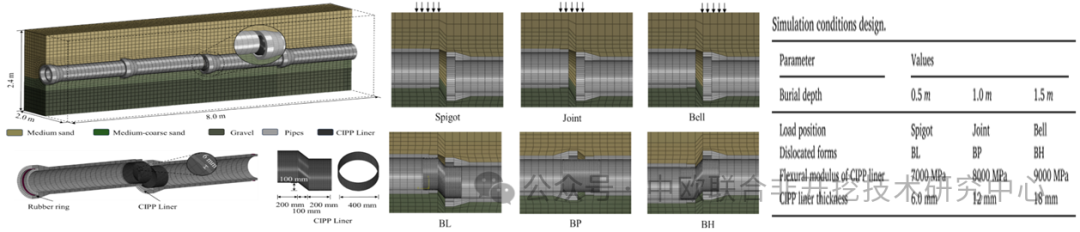
模型构建及实验设计
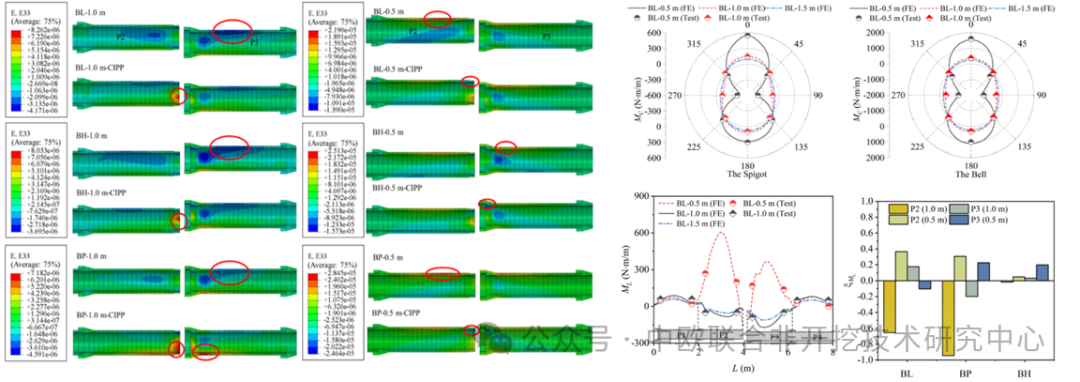
纵向应变及周纵向弯矩示意图